Janmashtami 2026 - Date, Nishita Kaal, Fasting Rules, and the Story the Festival Is Telling

Yagya Sachdeva
- August 29, 2026
- 7 min read
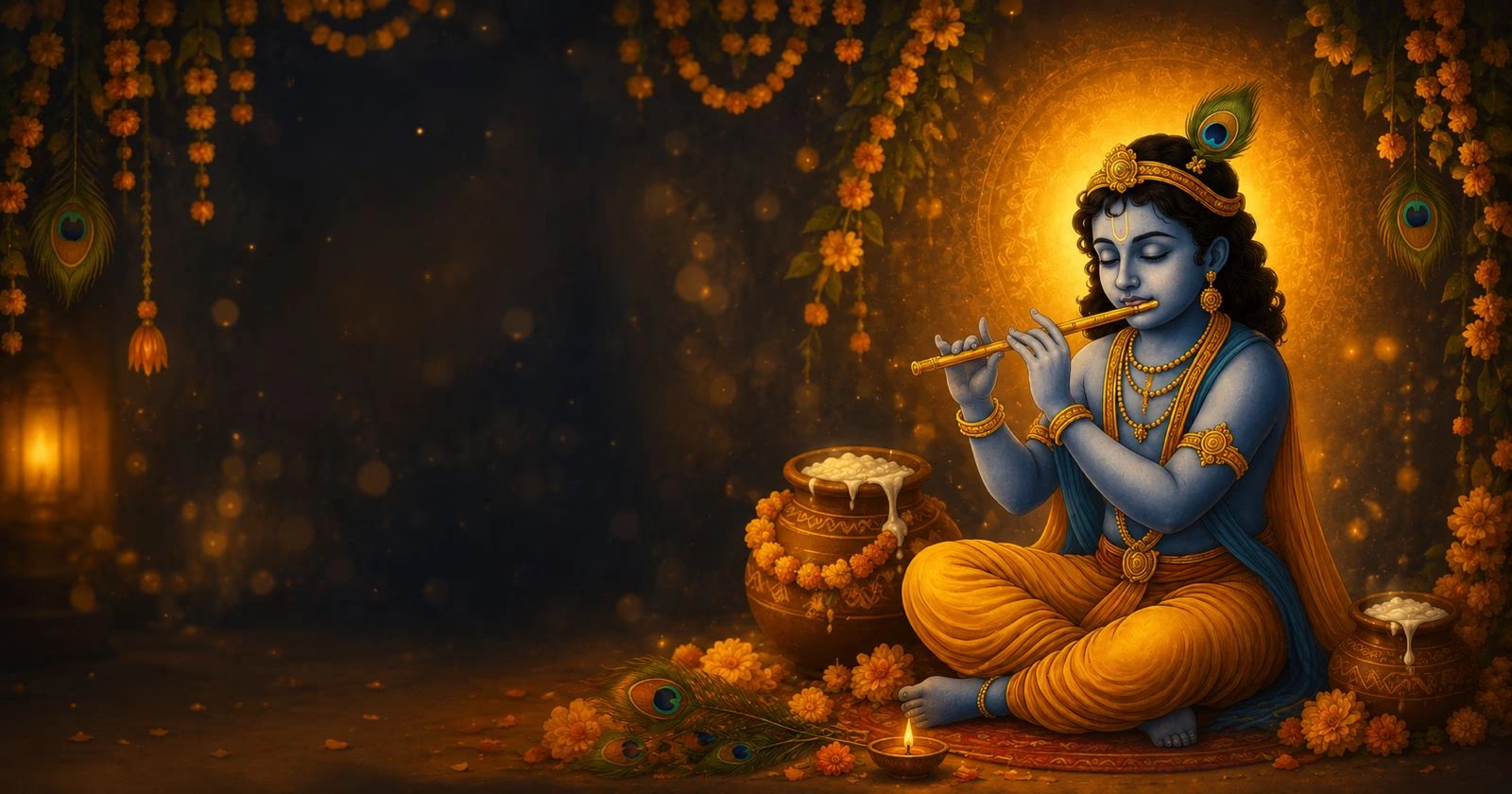
Janmashtami 2026 - Date, Nishita Kaal, Fasting Rules, and the Story the Festival Is Telling
He was born in a prison cell.
Not a palace, not a temple. A prison - at midnight, in a thunderstorm, to parents in chains. And yet the moment of his birth is described in the Bhagavata Purana as the most luminous moment the universe had seen in ages. Every guard fell asleep. The chains fell from Devaki's wrists. The doors opened on their own.
This is who Janmashtami celebrates. Not merely a birthday - the arrival of divine consciousness into the darkest possible circumstance, and the proof that the dark cannot hold what is truly luminous.
Here is everything you need for 2026 - date, timings, fasting rules, and what the tradition actually says is happening on this night.
Janmashtami 2026 - The Date
Smarta tradition (most Hindu households and major temples): Friday, 4 September 2026
Vaishnava and ISKCON tradition: Saturday, 5 September 2026
- Both dates are correct within their respective traditions - and the difference is not a dispute. It is a difference in which calendrical criterion takes precedence when the Ashtami tithi and Rohini Nakshatra do not fall cleanly within a single calendar day.
- The Smarta tradition looks for the Ashtami tithi to be in force during the Nishita Kaal - the sacred midnight hour. In 2026, the Ashtami begins on September 4 and extends through midnight. The Nishita Kaal of the night of September 4–5 falls while Ashtami is still active, so the Smarta observance is on September 4.
- The Vaishnava tradition gives primacy to the Rohini Nakshatra aligning at sunrise, which places their observance on September 5.
If you are in Mathura or Vrindavan - celebrations effectively span both nights.
Ashtami Tithi Timings
The Ashtami Tithi begins around 2:25 AM on 4 September 2026 and ends around 12:14 AM on 5 September 2026. These are standard panchang figures - slight variations by location are normal. Cross-reference with your local panchang for city-specific accuracy.
Nishita Kaal - The Most Sacred Window of the Night
- Nishita Kaal is not simply midnight. It is a precise calculation - the middle portion of the night, the exact window during which Lord Krishna is believed to have taken birth in Kansa's prison in Mathura over 5,252 years ago.
- It is not an auspicious window among many. It is the window. The one window during which the entire ritual of Janmashtami is meant to be performed - the abhishek of Bal Gopal, the aarti, the cradle ceremony, the offering of panchamrit.
- The Nishita Kaal puja window in 2026 is 11:55 PM to 12:42 AM -spanning the night of September 4 into September 5.
- Keep the idol or image of Bal Krishna before you during this window. Perform abhishek with panchamrit - milk, curd, honey, ghee, and sugar - which represents the five elements of creation being offered to the one who created them. Offer tulsi, makhan, misri. Light the aarti. Sing or listen to a bhajan. The entire puja should ideally be completed before the Nishita Kaal window closes.
- At exactly midnight within this window - traditionally at 12:00 AM - ring the bell, blow the shankha if you have one, and declare: Nand ghar anand bhayo, Jai Kanhaiya lal ki. Joy has come to Nanda's house. The child is here.
Why Midnight? What the Shastras Say
- The Bhagavata Purana - the primary scriptural source for the Krishna birth narrative - describes the birth as occurring at Nishita Kaal specifically. The choice of midnight is not incidental. It carries meaning at every level.
- Cosmologically, midnight is the deepest point of darkness - the point from which light can only increase. The birth of Krishna at this hour signals that the divine enters the world not at its most comfortable but at its most needed. Darkness is not the absence of the divine. It is the condition that calls it forth.
- Astrologically, the Rohini Nakshatra under which Krishna was born is governed by the Moon and associated with beauty, creativity, abundance, and fertility. The combination of Ashtami tithi - the eighth day, associated with transformation - and Rohini Nakshatra produces what Jyotish texts describe as one of the most auspicious birth configurations in the lunar calendar. The Vishnu Purana notes that this specific combination occurs rarely and marks the descent of something genuinely great.
- Practically, celebrating at midnight means you have fasted through the day and into the night - arriving at the moment of celebration with a body and mind that have been intentionally cleared. The hunger is not punishment. It is preparation.
Janmashtami Vrat - Fasting Rules
The Janmashtami vrat is one of the more flexible fasts in the Hindu calendar, with different levels of observance depending on tradition and capacity.
- Nirjala vrat - the strictest form, without water from sunrise to parana the following day. This is the form observed by highly devout practitioners and is described in the Hari Bhakti Vilasa, the primary text governing Vaishnava daily practice.
- Phalahar vrat - the most common observance. Only fruits, milk, curd, rock salt (sendha namak), sabudana, singhara flour, and water are consumed during the day. No grain, no regular salt, no cooked non-sattvic food.
- Sattvic phalahar - for those who cannot observe a full phalahar, a simplified version avoiding onion, garlic, grain, and meat while eating lightly through the day.
- What to eat during the fast: Fruits of all kinds. Milk and milk products - especially makhan and dahi, which are the foods most beloved by Krishna in the Bhagavata Purana. Sabudana khichdi made with sendha namak. Kuttu ki puri or singhare ke atte ki puri. Makhane. Panjiri made without grain.
- What to avoid: All grains and cereals. Regular table salt. Non-vegetarian food. Onion and garlic. Alcohol. Anything tamasic.
- The spirit of the fast: The Bhagavata Purana describes Devaki as having carried Krishna through extraordinary suffering - imprisonment, the loss of six children before him, the constant presence of death. The fast is a remembrance of that weight. Arriving at the midnight celebration with an empty body is a small echo of the emptiness she carried before his arrival.
Parana - When to Break the Fast
In 2026, the parana time is after 11:23 AM on September 5, when the Ashtami Tithi ends.
The fast is not broken at sunrise. It is broken after the Ashtami tithi has concluded - because the vrat is tied to the tithi, not to the clock. Breaking the fast before parana time, even by a few minutes, is considered to nullify the merit of the fast according to the Padma Purana.
The first thing consumed after parana is traditionally panchamrit - the same offering made to Bal Gopal at midnight, now received as prasad. This closes the ritual loop of the night.
What to Offer Krishna - The Chappan Bhog Tradition
- The Bhagavata Purana lists the foods beloved by Krishna across his life in Vrindavan - makhan, mishri, panjiri, kheer, dahi. The tradition of Chappan Bhog - 56 food items - originates from Govardhan Puja, when Krishna lifted the mountain for seven days and the gopis offered him food at eight intervals across each day. Seven days, eight times daily: 56 offerings.
- On Janmashtami, offering even a fraction of this - makhan, mishri, tulsi - with genuine devotion is considered equivalent in the Bhakti tradition, because the Bhagavata Purana's central teaching is that Krishna receives the offering not by its quality but by the bhava - the feeling - behind it.
- The leaf that is offered with full heart is received before the feast that is offered without one.
The Greeting - What Janmashtami Is Actually Saying
The greeting exchanged on Janmashtami - Jai Shri Krishna, Radhey Radhey, Nand ghar anand bhayo - are not merely pleasantries. They are declarations.
Nand ghar anand bhayo, Jai Kanhaiya lal ki - Joy has come to Nanda's house. Long live the child Kanhaiya. This is the announcement of the birth, reverberated across thousands of years.
Jai Shri Krishna - Victory to Shri Krishna. Not congratulations on his birthday. A declaration that the one who defeats adharma has arrived.
When you send this message to someone on Janmashtami, you are not wishing them well in the casual sense. You are invoking the energy of that midnight in Mathura - the energy that opened prison doors and broke chains - into the present moment.
That is what Janmashtami is. Every year, the same miracle. The divine choosing the darkest possible entrance. The chains falling. The doors opening.
Jai Shri Krishna.
Quick Reference - Janmashtami 2026
Date (Smarta): Friday, 4 September 2026 Date (Vaishnava/ISKCON): Saturday, 5 September 2026 Ashtami Tithi begins: 2:25 AM, 4 September 2026 Ashtami Tithi ends: 12:14 AM, 5 September 2026 Nishita Kaal (puja window): 11:55 PM – 12:42 AM (night of 4–5 September) Parana time: After 11:23 AM, 5 September 2026
Timings are standard panchang figures and may vary slightly by city. Confirm with your local panchang.
From all of us at Astro Vistaar - Jai Shri Krishna. May this Janmashtami bring you the same miracle it has always brought - the light that arrives at the darkest moment, the door that opens when no door should.
Astro Vistaar is an ISO-certified platform for astrology, occult sciences, and spiritual education