Kamakhya Sadhana - The Goddess Who Has No Face (And Why That's the Whole Point)

Yagya Sachdeva
- July 13, 2026
- 11 min read
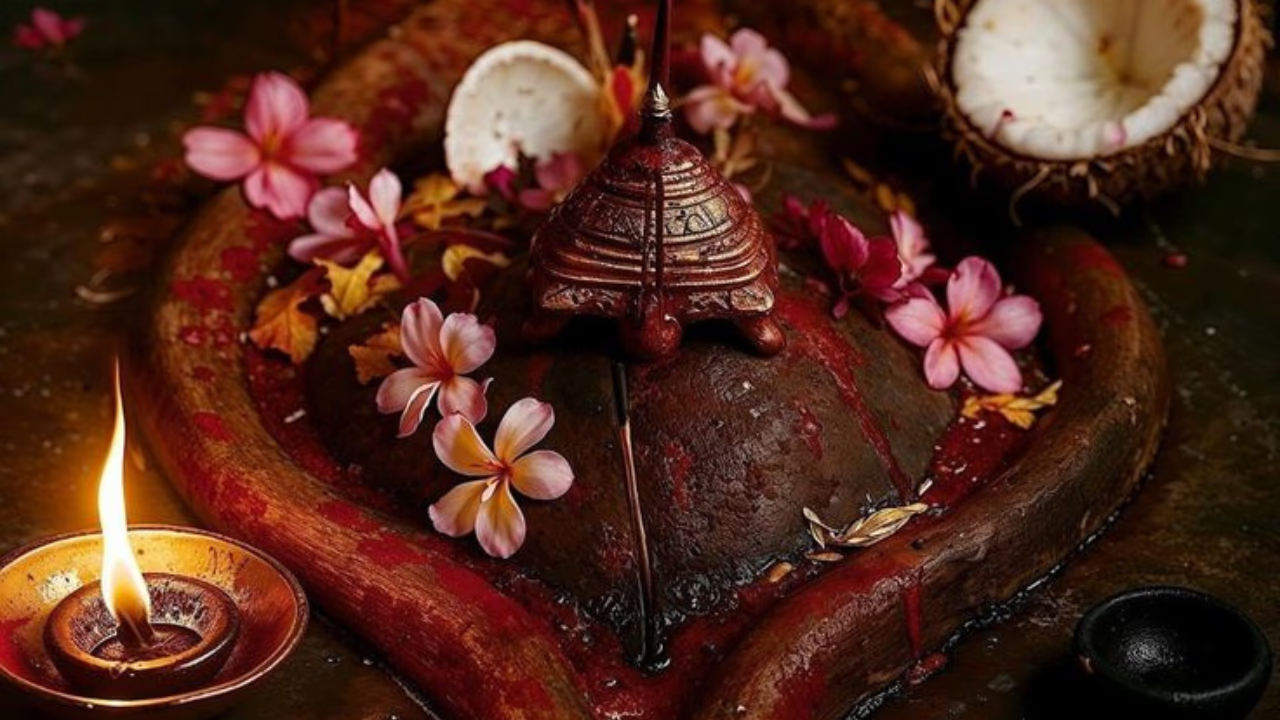
You go underground to meet her.
Down narrow stone steps, into near-darkness, the air thick and damp. No lamp will fully light this place. No idol waits at the bottom. No sculpted face, no painted eyes, no anthropomorphic form of the kind you find in every other temple in India.
What you find is a crack in a rock.
A natural fissure, shaped like a yoni, constantly wet from an underground spring that has been flowing since before recorded history. This is the sanctum of the Kamakhya Temple in Guwahati, Assam. This fissure in the earth is the goddess. This is what you come to worship.
Most people, the first time they hear this, feel something shift in them. Not confusion exactly. Something closer to recognition - like the mind suddenly running out of its usual categories and not minding at all.
That feeling is a good sign. It means you are ready to understand what Kamakhya actually is.
The Story That Started Everything
Once, Shiva's wife Sati walked into her father's fire and did not walk out.
Her father Daksha had organised a grand yajna and invited every god except Shiva - a deliberate insult to the man his daughter had chosen to marry. Sati went anyway. She stood there while her father humiliated her husband publicly. And she decided she would not continue to live in a body born from that man.
She stepped into the sacrificial fire.Shiva found out. And what happened next nearly ended the universe.
He picked up her body and began the Tandava - the cosmic dance of destruction - carrying her across the three worlds, unable to stop, unable to let go. The gods understood what this meant. A grieving Shiva in Tandava is not a metaphor. It is the dissolution of everything. Creation cannot continue while its witness is that lost.
So Vishnu acted. He used the Sudarshana Chakra - his spinning discus - and severed Sati's body as Shiva carried it. Piece by piece, across the length of the subcontinent, parts of her fell.Fifty-one pieces. Fifty-one sacred sites. Each one became a Shakti Peetha, a seat of the goddess in her most concentrated form.
At Kamakhya, in the hills of Assam, what fell was her yoni.
Her creative power. Her womb. The seat of all desire and all generation. The part of her that, in Tantric understanding, is not a body part but a cosmic principle - the point from which everything that has ever existed first emerged.
That is what is worshipped at Kamakhya. Not a representation of it. The thing itself.
Why This Temple Is Different From Every Other Temple You Have Visited
Most Hindu temples give you a murti - a beautiful, specific, named form of the deity. You look at the face, you make eye contact, you receive darshan. The relationship is human in its shape.
Kamakhya refuses this.
There is no face to look at. No eyes to meet. You descend into the earth, into the dark, and you encounter something that has no edges and no form. Just presence, and the sound of water, and the feeling of standing at the origin point of something very, very old.
The Kalika Purana - the 10th-century Sanskrit text that is the primary scriptural authority on this goddess - calls Kamakhya the yielder of all desires, the young bride of Shiva, and the giver of salvation. The Kamakhya Tantra goes further: Kamakhya is Kali herself, who is in all things the form of wisdom.
She is not a minor goddess. She is not regional folklore. She is the full Adi Shakti, the primordial feminine force, worshipped in her most unmediated form.
And the temple complex around her reflects this completely. The ten Mahavidyas - the ten wisdom goddesses of the Tantric tradition, Kali, Tara, Shodashi, Bhuvaneshwari, Bhairavi, Chhinnamasta, Dhumavati, Bagalamukhi, Matangi, and Kamala - each have their own shrine within the Kamakhya complex. Every major current of Tantric Shakti energy present in one place, all of it anchored by Kamakhya at the centre.
This is not a temple. It is a complete Tantric universe.
The Festival That Tells You Everything About This Goddess
Once a year, in June, the temple closes for three days.
The goddess is menstruating.
The priests leave. No rituals are performed. The cloth covering the sanctum is said to turn red. The Brahmaputra river, flowing below Nilachal Hill, is said to run red. The entire site goes into a state of sacred rest.
On the fourth day, the temple reopens and something extraordinary happens. Tens of thousands of Tantric practitioners - sadhus who have walked days to be there, scholars, devotees from every part of India and beyond - pour in. The red cloth from the sanctum, the Kamakhya Raktavastra, is distributed as prasad. People receive it and hold it like it is the most precious thing they have ever touched.
Because in the Tantric understanding, it is.The festival is called Ambubachi Mela. And the reason it matters is this: every other religious tradition in India treats menstruation as impure. A reason to turn women away from temples. A reason to build rules and restrictions and separate spaces.
Kamakhya does the exact opposite. The goddess herself bleeds. Her bleeding is the sign of her living power, her fertility, her ongoing creative force. Menstruating women are welcomed at Kamakhya when they are turned away everywhere else.
This is not a small theological detail. It is the whole philosophy of Kamakhya worship in a single fact.
This tradition does not look away from the wild, cyclical, uncontrollable feminine. It walks toward it. It says this is where the power lives.
If that sentence lands in you somewhere real, keep reading.
So What Is Kamakhya Sadhana?
Sadhana means sustained practice. The Sanskrit root points to a process of accomplishment - disciplined effort applied over time until something shifts permanently. It is not a single ritual performed once. It is a path.Kamakhya Sadhana is the path of deliberately building a relationship with this particular current of Shakti energy - not casually, not occasionally, but with the kind of consistency that actually changes something in you.
What that looks like in practice:
- You work with her mantra. Not just chanting it, but establishing a daily count - 108 repetitions, or 1008, over a defined and unbroken number of days. The mantra is a vibrational key. It tunes your energy to her frequency. The results of mantra sadhana are not mystical in the vague sense - practitioners describe increased magnetism, clearer intuition, a sense of something that was blocked in them beginning to move.
- You work with her yantra. A geometric form that holds her energy in physical space. You consecrate it, offer to it, sit before it. It becomes the point of contact between your practice and her presence in your environment.
- You structure your puja - the daily ritual of offering and invocation - according to the Kulachara Tantra Marga, the specific lineage of Kamakhya worship that has been maintained on Nilachal Hill since at least the 7th century. Red hibiscus. Sindoor. Offerings chosen not randomly but for their specific resonance with her nature.
And critically - you time your intensive practice to the Navratris. The Gupt Navratris in particular, the hidden Navratris observed in the Magh and Ashadha lunar months, are the windows during which Tantric sadhana for the Mahavidyas produces results at a completely different rate than at other times of year. Kamakhya Sadhana done consistently is powerful. Kamakhya Sadhana done during Gupt Navratri is something else entirely.
What Kamakhya Sadhana Can Do
The Kalika Purana names her explicitly as Kama Roopini - one who embodies the form of desire. She does not ask you to transcend your human wants. She works with them.This makes her the correct Sadhana for three types of situations in particular.
- The first is love, desire, and attraction. Kamakhya Sadhana for Vashikaran - drawing people toward you, creating genuine magnetic pull, resolving situations where someone's feelings exist but are blocked - is among the most effective approaches in the entire Tantric framework. The goddess of desire working on the energetics of desire is not a coincidence. It is precision.
- The second is creative power and worldly fulfilment. Artists, entrepreneurs, practitioners, anyone who needs to generate - Kamakhya Sadhana builds a particular kind of potency that is hard to describe until you experience it. The practitioner begins to feel like a source rather than a person waiting for things to happen.
- The third is liberation. This surprises people who think Tantra is purely about worldly power. But the Kalika Purana states it directly: Kamakhya is the most important Devi to worship for moksha. The path to liberation here runs not through denial of the world but through the complete embrace and transformation of desire itself. Kama becoming Moksha. That is the deepest promise of this Sadhana.
Who Is This For - Honestly
Not everyone.
Kamakhya Sadhana is not a beginner practice in the sense of being casual or low-stakes. It is beginner-accessible - you do not need years of prior practice to start - but it demands genuine commitment. The goddess does not respond to occasional interest. She responds to the person who shows up with the same sincerity on day forty as on day one.
- This is for you if the Shakta Tantric path calls you - if the idea of the divine feminine as the active creative force of the universe feels true in your body, not just interesting in your head.
- This is for you if you are done with spiritual paths that ask you to suppress your desires, your needs, your hunger for things. Kamakhya is the goddess who says: bring it all. Bring your longing, your ambition, your creative fire, your grief, your want. All of it is fuel here.
- This is not for you if you want a single ritual that solves a single problem. That is a different kind of work. Sadhana is a relationship, not a transaction.
How We Teach This at Astro Vistaar
Taught by practitioners with active, initiated practice in this tradition. Not people who have read the Kalika Purana - people who have done the Sadhana, who know what it feels like when the mantra starts landing differently around day twenty-one, who can tell you what to expect and what to do when the practice starts producing real results.
The course covers the full framework: the mythological and scriptural foundation, the mantra system, yantra consecration and worship, daily puja structure, the energetic preparation the tradition requires, the Vashikaran and desire-fulfilment practices within the Dakshinachara path, and how to work the Navratri calendar for maximum momentum.
If you feel pulled toward this - even if you cannot fully explain why - that pull itself is information worth taking seriously.
Reach out on WhatsApp or write to us at hello@astrovistaar.com. Please tell us where you are and what you are looking for. We will be honest about whether this is the right fit.
Astro Vistaar is an ISO-certified platform for astrology, occult sciences, and spiritual education. Our Tantric courses are taught by initiated practitioners within living lineages of practice.