Working With Jinn - The 3-Day Intensive Course in Islamic Tantra

Yagya Sachdeva
- August 12, 2026
- 7 min read
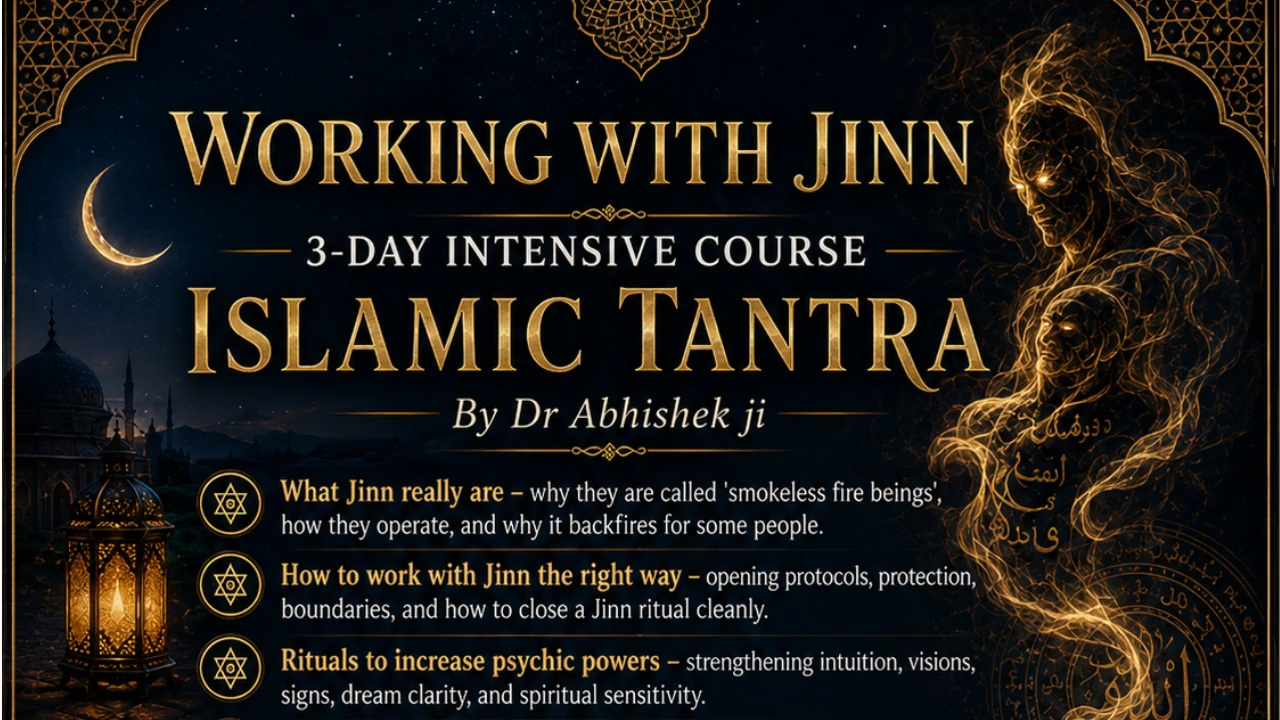
Working With Jinn - The 3-Day Intensive Course in Islamic Tantra
Most people know Jinn only through stories.
The shape-shifters of Arabic folklore. The genies of Western imagination. The terrifying entities of horror films. The whispered warnings from grandparents. Or the isolated invocations found on obscure forums online - copy-pasted prayers with no context, no protection, and no understanding of what is actually being called.
None of these is the Jinn tradition.
The Jinn tradition is a complete ritual system. It has been practiced across the Islamic and Arabic world for over a thousand years -documented in scripture, developed by scholars, refined by practitioners across generations. It has its own logic, its own safety requirements, its own hierarchy of intelligences, and its own precise method for approaching different intentions in different ways.
This course, taught by Dr Abhishek Ji at Astro Vistaar, teaches that system.
Not a collection of spells. The system behind Jinn ritual practice.
Who Should Not Join This Course
Dr Abhishek Ji is direct about this - and the directness is itself a signal of how seriously this material is treated.
- Do not join because Jinn sound frightening or exciting. Do not join if your only intention is casual experimentation. Do not join if you are unwilling to learn protection, grounding, and closure. Do not join if you want to copy an invocation without understanding the current behind it. Do not join with the intention of using advanced occult work irresponsibly.
- This course is for students who want to understand how the system is actually approached. Students who want a course they can return to repeatedly - because the system is larger than one ritual, and what you learn compounds with time.
If that description fits you, read on.
Who the Jinn Actually Are
- The Quran is unambiguous: Jinn are real. They are created from smokeless fire - distinct from angels, distinct from humans, with their own nature, their own classes, their own temperaments, and their own way of being approached.
- Every Jinn is not the same. Every Jinn is not approached in the same manner. The mistake most people make - including most people who dabble in Jinn invocation online - is treating all Jinn as a single category that responds to a single type of approach. That is not how the tradition works. And it is precisely why uninformed attempts produce unstable, unpredictable results.
- The course begins here: understanding what Jinn are within the framework of Islamic Tantra. Their nature, their classifications, how they differ from angels, and why the approach must be matched to the specific class and purpose of the working.
The Seven Jinn Kings - The Heart of the System
This is where the course becomes genuinely unique - because the Seven Jinn Kings system is not something most people outside serious Islamic occult practice have ever encountered.
In the Jinn tradition, seven great Kings govern seven domains - each connected to one day of the week. The day you work, the King you approach, and the purpose of the ritual are not separate decisions. They are one decision. The King governs the domain. The day is when that King's power is most accessible. The ritual is the correct form of approach for that King's nature.
The weekly Jinn system taught in this course:
Sunday - Healing-oriented rituals Monday - Psychic powers and spiritual sensitivity Tuesday - Protection Wednesday - Mind expansion and internal blockages Thursday - Finance, business, and material movement Friday - Love, passion, and reconciliation Saturday - Enemies, opposition, and strong interference
This is where the course delivers its most important teaching: the strongest ritual is not always the correct ritual. The correct ritual depends on the actual problem. A practitioner who tries to solve a Thursday finance problem with a Friday love ritual is not just ineffective - they are working at cross purposes with the entire system. The weekly structure is not arbitrary. It is the architecture of Jinn ritual practice.
What the Course Actually Teaches
The structure of every Jinn ritual in this course follows one sequence:
PREPARE → PROTECT → INVOKE → REQUEST → CLOSE
Each stage is taught in full. Not memorised as words — understood as a structure that the practitioner can apply across different intentions, different Kings, and different situations.
- Understanding Jinn beyond mythology - their nature, classifications, differences from angels, and why every Jinn cannot be approached in the same way.
- The Seven Jinn Kings - how the weekly system is organised and why the day, the King, and the purpose of the ritual are always connected.
- Opening a Jinn ritual correctly - the complete opening structure using candle focus, visualisation, and specific ritual words before any request is made.
- Protection before invocation - aura protection, meditation, light visualisation, and maintaining a clear boundary. This is not an optional module. Dr Abhishek Ji treats protection as foundational - the practitioner does not enter spirit practice carelessly.
- Proper closing and disconnection - a specific closing procedure with gratitude and closing words to formally end the contact. Rituals that are not properly closed remain open. This is one of the most commonly skipped steps in informal Jinn practice - and one of the most consequential to skip.
- Training the practitioner's mind - intention, emotion, and concentration are treated as central to ritual practice. The candle is a representation of fire. It is not the source of the ritual itself. What the practitioner brings into the working shapes what comes out of it.
A Complete System for Different Intentions
One of the most valuable things about this course is that every problem is not approached with the same ritual. The classes contain separate Jinn rituals for genuinely different situations.
- Relationships - separate methods for strengthening passion in an existing relationship, reconciliation, emotional connection, third-party interference, and difficult relationship situations. The course distinguishes between existing love, passion, reconciliation, and third-party removal - rather than lumping everything under one generic "love spell."
- Reversal and difficult situations - a separate ritual structure for situations already moving negatively: repeated negative circumstances, difficult habits, business problems, examination concerns, and situations requiring reversal rather than attraction.
- Office politics and competition - dedicated material for corporate politics, manipulation by colleagues, competitors, professional interference, and people repeatedly creating obstacles. This application alone makes the course relevant to every working professional and business owner who has ever felt their career is being sabotaged from inside.
- Abundance - taught as more than simply "getting money." The abundance ritual can be directed toward money, business opportunities, useful connections, affection, growth, and increasing what is specifically missing from a person's present situation.
The Ritual Tools and Why They Are Used
The course goes further than most - it does not just name the tools. It teaches why each one is used and what it does inside the working.
Different rituals make use of black candles, mirrors, smoke, crystals including Bloodstone, Agate, Amethyst, and Moonstone, as well as healing oil, protection oil, money and manifestation oils, and stronger oils for opposition-related practice.
But the deeper lesson, as Dr Abhishek Ji teaches it, is why these materials are used:
- How an intention is attached to a ritual object - so that a crystal is ritually connected with the required purpose rather than simply placed nearby.
- Who keeps the ritual object - when the practitioner retains it versus when it goes to the person receiving the working.
- How long the object remains active - certain crystals are kept for a defined period and then disposed of rather than kept permanently.
- Using photographs and visualisation - how visual references strengthen concentration when the ritual concerns a specific person or situation.
- Grounding after spirit practice - root chakra meditation and grounding taught for practitioners who begin experiencing energetic exhaustion from repeated spiritual practice.
- Protecting the space itself - protection through the four cardinal directions when the concern involves the surrounding environment rather than just one person.
What You Actually Take From This Course
By the end of three days, you will have been taught:
The Seven Jinn Kings and the weekly Jinn system. Opening rituals. Aura protection. Invocation structure. Closing and disconnection. Love and reconciliation rituals. Third-party removal. Situation reversal. Corporate politics rituals. Abundance rituals. Healing-oriented ritual structure. Psychic power development. Protection from hostile influence. Mind expansion. Money, business, and client rituals. Enemy and opposition rituals. Crystal binding. Ritual oils. Mirror and candle use. Visualisation. Grounding. Working for another person. Handling separate client rituals. Space protection. And practitioner judgement for choosing the correct ritual.
This is not a collection of seven spells.
It is an introduction to an entire Jinn ritual system - from understanding who you are approaching, to choosing the correct ritual, establishing protection, directing the intention, and knowing how to close the contact properly.
Only on Astro Vistaar. Taught by Dr Abhishek Ji. Reach out on WhatsApp or write to us at hello@astrovistaar.com. Tell us what you are looking to learn and where you are in your practice. We will help you understand whether the Jinn Magick Course is the right fit for you.